
Responsible AI: 7 Principles Every Sustainability Manager Should Know
Artificial intelligence (AI) is everywhere now: at home, in schools, at work. We use it to speed up processes, search for information and generate ideas, and sustainability is no exception. Sustainability teams are quickly adapting to a radically changed working reality, entrusting data collection, systemizing, calculations and other effort-intensive processes to AI tools.
But this convenience comes at a price that we don't see from our warm offices: emissions and water demand are growing, reducing biodiversity. Moreover, more and more power is concentrated in the hands of a few tech corporations. This has been called the newest form of resource extraction, in which a handful of companies increasingly control land, water and energy. It also opens up a climate justice discussion: the benefits of AI are concentrated in wealthy countries and companies, while the environmental and social costs are more often paid by those who profit from it the least.

The question sustainable businesses are trying to answer today: do the AI tools we use bring more benefit than harm? And how can we use these tools responsibly?
What Is Responsible AI?
Seven Principles in Practice
In this new space, we each define responsible AI a little differently. According to the EU expert group's Ethics Guidelines for Trustworthy AI, artificial intelligence should be lawful, ethical and technically robust. In practice, this means AI complies with the law, respects human rights and values, works accurately and safely, and its results can be verified. From documents such as the EU AI Act, the Ethics Guidelines for Trustworthy AI, the OECD AI Principles and the ISO/IEC 42001 standard, we can identify the core principles of responsible AI:

1. Human oversight
Artificial intelligence can give an answer that sounds convincing but is wrong. That's why decisions, especially those that shape your company's sustainability strategy, must be made by a person.
What to do
- Leave the final word to a person. Every number that goes into a report should be reviewed by a responsible person.
- Set boundaries. Define which decisions AI cannot make without a human, for example when assessing employees or suppliers.
- Train your team. People who understand what AI can and can't do are less likely to copy its mistakes. It's also an AI Act requirement: companies must take measures to support their employees' AI literacy, so it's worth documenting your training.
2. Transparency
People should know when they are interacting with artificial intelligence or reading content it has created. And you should know where every result came from.
What to do
- Choose tools that show the source for every number and statement.
- Record where AI contributed, so you can explain it to an auditor or the board.
3. Accountability
The person and organisation using artificial intelligence are responsible for its results. This requires clear rules: who uses which tools, and for what.
What to do
- Make a list of your AI systems and assign them to risk categories under the AI Act. Pay particular attention to high-risk areas such as recruitment.
- Appoint a responsible person and introduce an AI policy: which tools are allowed, what data must not be uploaded and who is responsible for the results.
- Keep track of deadlines. Prohibited AI practices have applied since February 2025, and after this year's Digital Omnibus, requirements for high-risk systems apply from 2 December 2027.
- Include AI in your ESG risk and double materiality assessment. Assess how AI use affects data security, employee skills and your carbon footprint.
4. Fairness
Artificial intelligence learns from data, so it can reproduce the bias contained in it. Fairness also covers the people who build it. Data is often labelled, and harmful content filtered, by low-paid workers in poorer countries, and some of them are training systems that may eventually replace their own jobs. For sustainability managers, this is a familiar supply chain risk, only digital.
What to do
- Find out who owns the tool and how it is trained. Who labels the data, and under what conditions? Does the provider have a code of conduct for its supply chain?
5. Privacy
Sustainability data contains a lot of sensitive information about employees, suppliers and finances. It's important to know where it goes.
What to do
- Pay attention to location. Where are the servers physically located, and where is your data stored? Data stored in the EU is covered by the GDPR (General Data Protection Regulation), and responsibilities are clearer.
- Make sure your data isn't used to train models.
- Define what data must not be uploaded to public chatbots.
- Review your contracts with AI providers for data confidentiality and intellectual property rights.
6. Security
For many companies, the biggest risk is shadow AI: tools that employees use without the organisation's knowledge. In a 2026 Thomson Reuters survey, around 34% of professionals admitted to using unapproved AI tools at work, most often because no approved tool exists or the one they have doesn't fit the job.
What to do
- Offer suitable approved tools. This is the best way to reduce shadow AI.
- Check the provider's security measures: multi-factor authentication, access rights and separation of your data from other clients.
7. Societal and environmental wellbeing
AI infrastructure runs in data centres that use electricity, water, land and equipment. According to the International Energy Agency (IEA), global data centres will consume twice as much electricity by 2030 as they do now, around 945 TWh a year, and AI is the main driver of this growth.
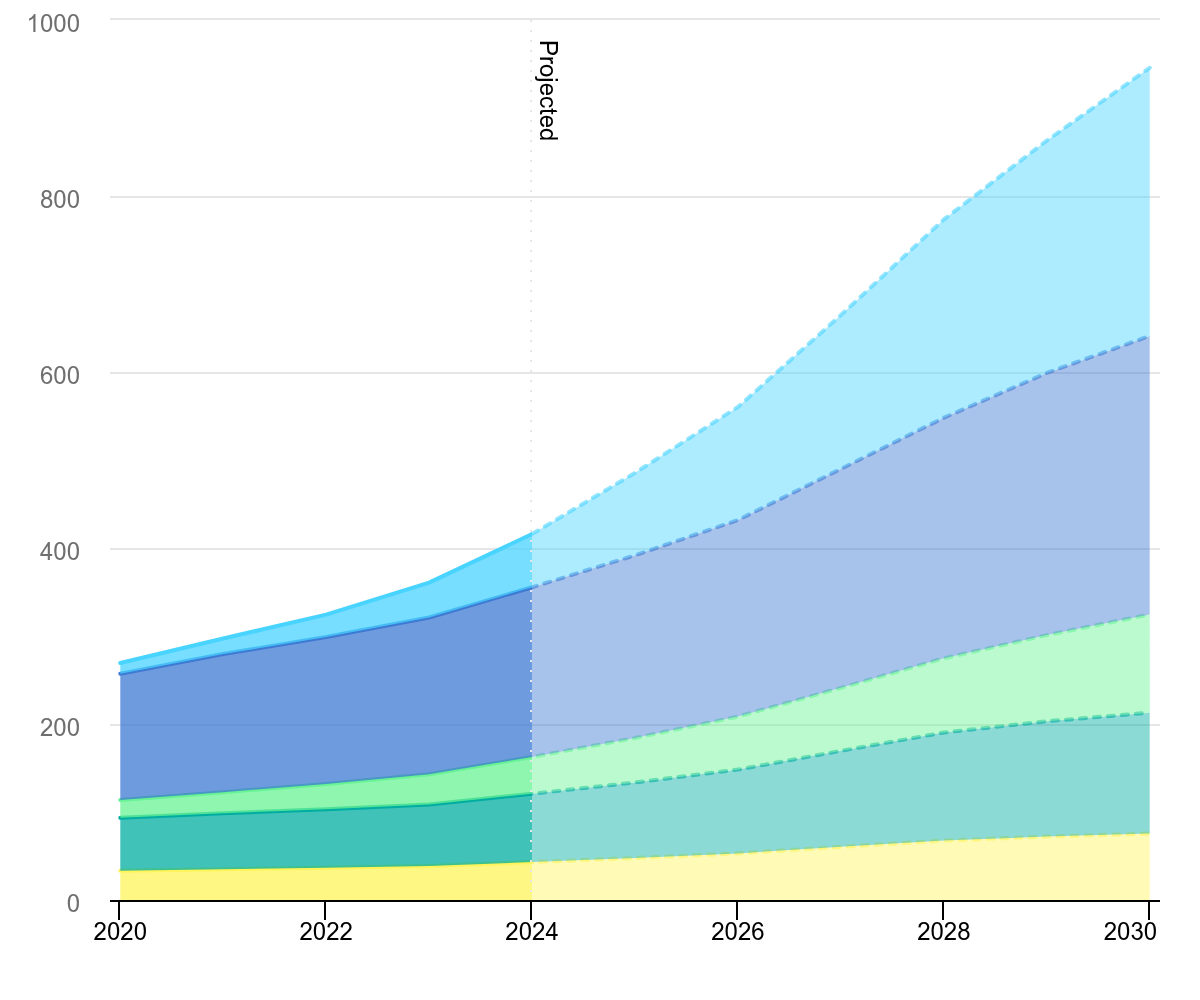
Data centres also have a negative impact on nearby communities. They need large amounts of local water and land, their cooling systems create noise, and their high electricity demand can push up electricity prices across the whole region.
Sustainability managers should do their homework here, because AI use shows up in their company's Scope 3 emissions. Ask your provider for data on its data centres' energy and emissions, as this gives a more accurate calculation than one based on spend alone. Large companies already publish such data: for example, Google reports that the energy footprint of a Gemini prompt fell 33-fold in a year.
What to do
- Choose a tool whose data centres run on clean energy. Whether you use ChatGPT, Claude, Gemini or another tool also determines your AI footprint. Find out where the provider's data centres are located and what sources generate the electricity that powers them.
- Check how clean energy is calculated. Common claims such as carbon neutrality or 100% clean energy are often based on offsetting alone, so check the sources. Such claims are restricted by the EmpCo Directive.
- Look into the impact on local communities. Are data centres being built in water-scarce regions? Have environmental and noise impact assessments been carried out? Were residents consulted before construction, and what does the community get in return, such as jobs or waste heat?
- Assess your AI provider like any other supplier. Include it in your supplier assessment process. Does it publish a sustainability report with energy, water and emissions data for its data centres? Does it have a code of conduct for its supply chain? A company that doesn't publish this data raises questions.
- Use AI sparingly. Every prompt uses electricity and water, so it's worth thinking about when artificial intelligence is really needed. Simple tasks, such as proofreading or a short summary, don't need the most powerful model, as smaller models use less energy. Where a regular search or a calculator will do, don't use AI. And instead of regenerating the same text or image many times, state clearly what you need from the start.
"Don't use AI for tasks you could do yourself with a minute of thought! It's good for both the planet and our brains," says Austina Tarvydaitė, creator of Planet Positive Platform.
We can think of AI responsibility like car safety rules. Before a car goes on the market, it must be certified: that's the manufacturer's duty. But how it's driven is the driver's responsibility. It's the same with AI tools: the responsibility is ours, with every keystroke.
How to Choose a Responsible AI Tool for Sustainability?
The sustainability manager's role is extremely demanding. It means ensuring compliance, shaping strategy, collecting ESG data from every department, answering client and bank questionnaires, and following regulation that changes faster than organisations can adapt. All of this often falls to a team of just a few people with a lot of responsibility but little formal authority.
On top of that, checking every AI tool against all these principles is hard for a small team. That's why the best and fastest solution is to trust people who have already done part of this homework.
Over seven years, Planet Positive has worked with more than 100 companies, and we kept seeing the same gaps: data scattered across emails and spreadsheets, reporting that drags on, and nobody remembering where the emission factors came from. So when we met Austina Tarvydaitė and Vladislav Budiak, the creators of the Twarus technology, who were building an AI tool for sustainability reporting, we realised we had a strong foundation for a trustworthy tool. The only thing missing was a person by your side. So we combined Twarus technology with the expertise of Planet Positive consultants and created Planet Positive Platform: an AI tool for sustainability work, with a sustainability consultant by your side.
We built the platform on the same principles:
- Transparency. You see the source and emission factor for every number, and every section of the report keeps links to the data.
- Human oversight. AI does the most time-consuming work, but decisions stay with your team. You can collect data in two ways: send a ready-made ESRS questionnaire to the responsible colleagues, or upload invoices and other documents for the AI assistant to read. Either way, you review every number before it goes into the report. The platform prepares the first draft of the report, and you edit and approve it. If questions come up at any step, you can consult a Planet Positive sustainability consultant.
- Privacy. Sustainability data contains a lot of sensitive information about employees, suppliers and finances, so all your data is stored in the European Union and is covered by the GDPR. Each company's data is separated from other clients, and login is protected by multi-factor authentication.
- Environment. The platform runs in Google Cloud's data centre in Hamina, Finland. It is housed in a former paper mill and cooled with seawater, and according to Google's 2023 data, 98% of its electricity was carbon-free.

- Built for sustainability. The platform is based on the GHG Protocol, CSRD and VSME requirements. It calculates Scope 1, 2 and 3 emissions, shows the emission factor and its source for every number, and lets you set your own factors when needed. The AI assistant is built for sustainability only, so it answers questions about the CSRD and your data. Every section of an uploaded report is checked against sustainability standards, with an explanation of what's missing. When standards change, the platform is updated.
"Over the past few years, we've talked a lot with sustainability managers and listened to what they find the most difficult. We wanted to create a tool that would truly lighten that load," says Miglė Makuškaitė-Survilė, founder of Planet Positive.

Sources
- European Commission: Ethics Guidelines for Trustworthy AI (2019)
- EU AI Act, Regulation (EU) 2024/1689
- Digital Omnibus on AI, Regulation (EU) 2026/1744
- OECD AI Principles
- ISO/IEC 42001:2023
- Bristows: The Digital Omnibus on AI, changes to AI literacy
- The Logic: Thomson Reuters shadow AI survey (2026)
- IEA (2025): Energy and AI, Energy demand from AI
- DatacenterDynamics: Google's electricity and water use in 2025
- DatacenterDynamics: Google projects in Finland and 300 ha of cleared forest (2026)
- Baxtel: Google data centres in Finland, including Hamina (2026)
- EmpCo Directive, (EU) 2024/825